
Recap: What impact will the major investment package really have?
Lots of debt, little impact? What can be expected from the historic investment package half a year after its adoption – and how can its success be measured?
BY
FORUM NEW ECONOMYPUBLISHED
10. DECEMBER 2025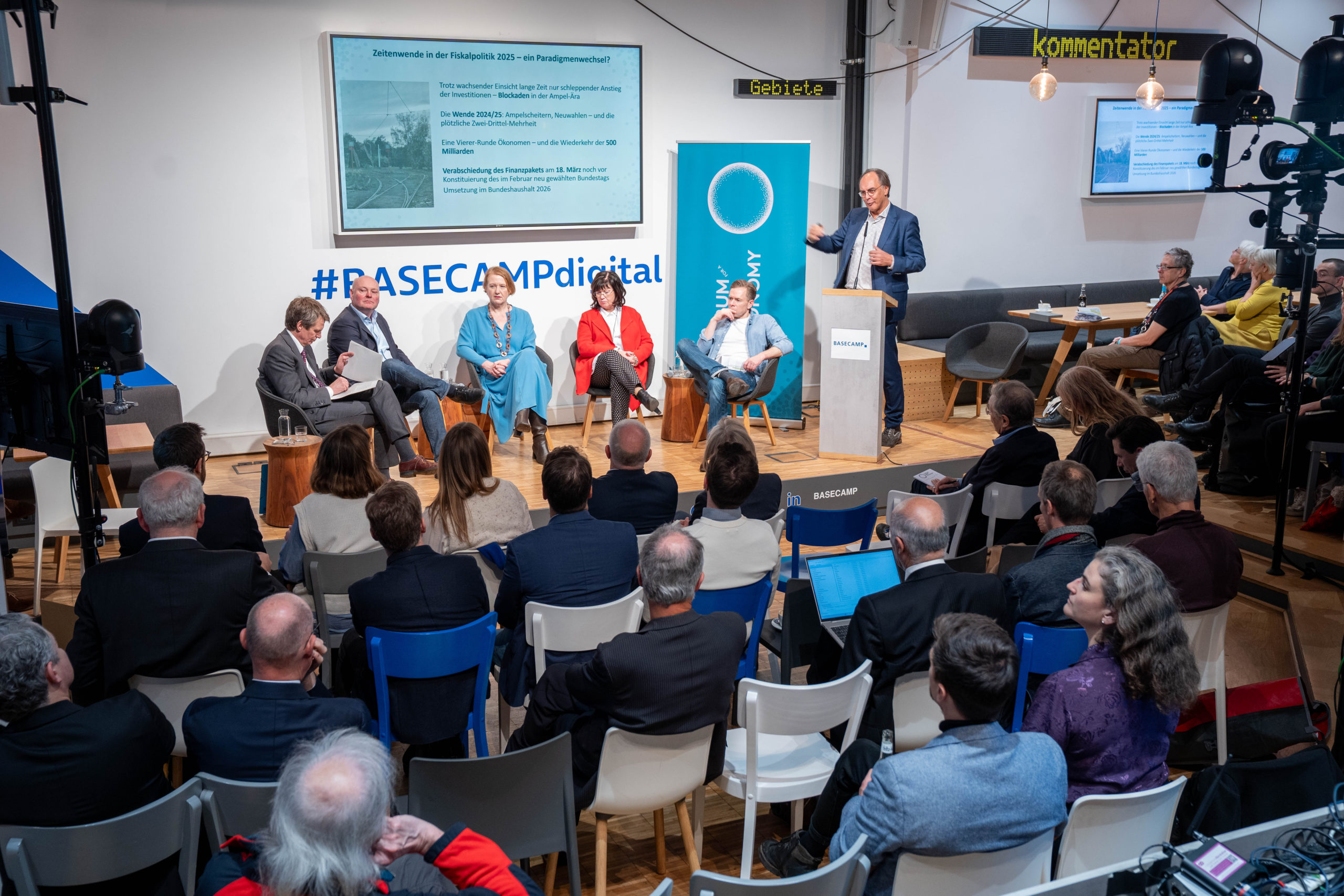
Half a year after the adoption of Germany’s 500-billion-euro investment package, the Forum New Economy gathered leading policymakers and experts to take stock. Moderated by Thomas Fricke, the discussion brought together State Secretary Steffen Meyer, Mark Schieritz, Mayor Christine Herntier, Lisa Paus, Achim Truger, Jakob von Weizsäcker, Laura Krause, and Michael Hüther to examine expectations, measurable outcomes, and public visibility of the “historic” initiative.
Thomas Fricke opened with the long political backdrop: decades of underinvestment, persistent blockages, and the difficulty of enabling major public investment under Germany’s debt brake. The new special fund therefore marked a genuine paradigm shift – even though public debate since its adoption has been dominated by concerns about “accounting tricks,” shifting expenditures, and a lack of true additionality.
Representing the Federal Ministry of Finance, Steffen Meyer stressed that the package lays the foundation for a broad investment offensive: 100 billion euros for climate and energy, 100 billion for Länder and municipalities, and 300 billion for infrastructure, combined with an investment quota of over ten percent in the core budget. He highlighted record-level federal investment plans, strict monitoring mechanisms, and a newly established Investment and Innovation Council. What matters most, he argued, is the long-term planning certainty the package provides — enabling capacity expansion and encouraging private-sector investments.
Offering a municipal perspective, Christine Herntier, mayor of Spremberg, described how her town will receive 6.6 million euros — welcome, but insufficient to tackle an investment backlog of 80 million. She illustrated the daily reality of many municipalities: high district levies, demographic pressures, bureaucratic hurdles, and lengthy approval processes. Even urgent projects take years. The special fund helps, she said, but it does not address the structural underfunding of local governments.
From the federal political angle, Lisa Paus argued that the Greens’ approval of the constitutional amendment had been right, as Germany needs a long-term solution. Yet the implementation has been deeply disappointing: large parts of the spending are not additional, the investment quota is inflated through accounting reclassifications, and expensive political compromises have limited the growth potential. As a result, crucial transformation steps — especially for climate policy and competitiveness — are being delayed.
Achim Truger explained the German Council of Economic Experts’ analysis: in an optimal scenario, the investment package could raise GDP by 4.5–5 percent by 2030. In reality, due to limited additionality and non-investment spending, the effect is closer to 1.8 percent. At the same time, he warned against portraying the entire borrowing volume as poorly invested, since a significant share stems from defence spending under the constitutional exemption. Still, the fundamental problem remains: the federal budget is structurally underfunded. Without reform of the debt brake and a sustainable strengthening of municipalities, future investment capacity cannot be secured.
The discussion highlighted how tightly these challenges are intertwined: hopes for quick stimulus collide with labour shortages, planning delays, political constraints, and an uncertain global environment. While Meyer expressed confidence that public spending would spark a self-sustaining upswing, Paus and Truger cautioned that insufficient planning capacities, political reallocations, and structural fiscal pressures could significantly weaken the package’s potential.
In the end, one conclusion stood out: the special fund creates historic opportunities — but its real impact will depend on whether Germany can spend the money effectively, remove bureaucratic and institutional blockages, and rebuild its long-term public investment capacity.