
Quick & New -
the New Economy Ticker
The latest news, debates, proposals and developments on new economic thinking at a glance.
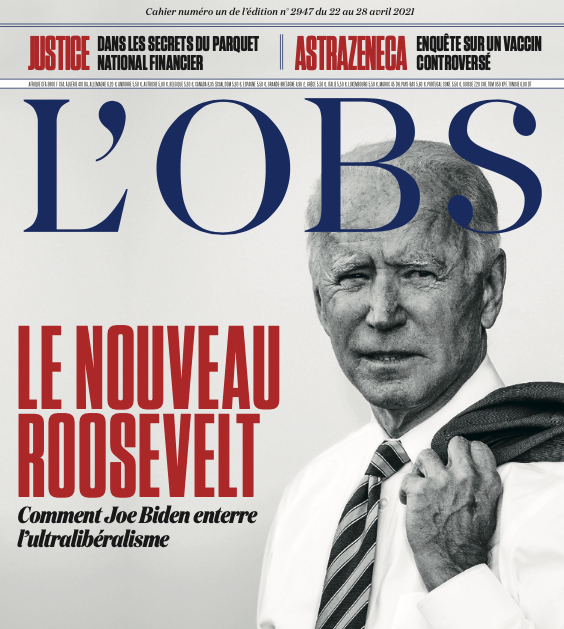
Is Joe Biden to F. D. Roosevelt what his new spending and fiscal plans are to the New Deal? This image is crystallising more and more. In our recent series of articles analysing the ´rescue plan` first and the ´infrastructure plan` then, we already hinted that Joe Biden’s proposals were close to ending the era of neoliberal policies so cherished by Reagan and his successors, and that – as discussed in our December Short Cut with James Galbraith – with Joe Biden in power the possibility of a new New Deal was approaching.
Now even the influential French weekly magazine L’Obs promotes Joe Biden as the new Roosevelt and devotes 10 very interesting pages to him, where it also addresses the question of whether the EU is prepared to embrace this paradigm shift in terms of public spending and fiscal rules coming from overseas.
Not only are the multilateral institutions‘ economists relaxed about the massive deficit spending by rich countries connected to rescue packages due to the pandemic, but they are also in favour of spending on education or redistributive measures. The International Monetary Fund, for instance, has proposed a ‘solidarity’ tax on high earners and very profitable companies in order to pay up to bolster social cohesion in light of the pandemic.
Quoting Martin: „New Consensus: Spend big on public health. Fiscal probity, long the core of IMF prescriptions (the joke was that the initials stand for “it’s mostly fiscal”), is no longer about reining in public spending but about getting value for money — and spending more where the value can be found.“
The full article can be found here.
The new Economy and Society Initiative(EIS) will help develop a new “common sense” about how the relationship between governments, markets, and people should be structured to meet society’s biggest challenges.
After a two-year, $10 million exploratory grantmaking effort to examine potential successors to neoliberalism, the Hewlett Foundation’s board approved a further five-year, $50 million initiative to continue the development of a new paradigm.
Read more about the five year initiative – here. The entire grant making strategy of the EIS is available – here.
Report release on Thursday, March 11 at 8:00 AM EST (13:00 GMT)
In the report, INET´s Commission on Global Economic Transformation calls on developed countries to ensure vaccine equity, debt relief, and fiscal capacity for the Global South in response to the COVID-19 pandemic and economic crisis. Register here for the press conference featuring Joseph Stiglitz (co-chairing the CGET), INET President Rob Johnson, and Commissioners Jayati Ghosh, Rohinton P. Medhora, and Michael Spence.
In a recent contribution for INET, Claudia Sahm says that the Congress should refrain from following the unfunded fears of “inflation hawks” as that would result in doing too little – and the disastrous consequences of a timid policy response, such as that of the Great Recession are all too vivid and provide a valid ground for not running that risk anymore. The risks that an insufficient relief package could leave millions of American families unattended, increase inequality, and needlessly prolong the recovery are too high and, conversely the prospects of overheating the economy are too little to justify the risk of letting a big chunk of the population suffer the consequences of the pandemic driven crisis.
Check out the essay where the author goes through the main points informing the debate around the topic and proves the Congress has indeed solid grounds for going big.
OUR MAIN TOPICS







New Paradigm
NEW PARADIGM
After decades of overly naive market belief, we urgently need new answers to the great challenges of our time. More so, we need a whole new paradigm to guide us. We collect everything about the people and the community who are dealing with the question of a new paradigm and who analyze the historical and present impact of paradigms and narratives – whether in new contributions, performances, books and events.
Redefining
the role of
the state
REDEFINING
THE ROLE OF
THE STATE
For decades, there was a consensus that reducing the role of the state and cutting public debt would generate wealth. This contributed to a chronic underinvestment in education and public infrastructure. New research focuses on establishing when and how governments need to intervene to better contribute to long-term prosperity and to stabilize rather than aggravate economic fluctuations.
Remaking
finance
REMAKING
FINANCE
More than a decade after the financial crisis there still seems to be something seriously wrong with the financial system. Financial markets still tend to periodically misprice risk and contribute to boom and bust cycles. A better financial system needs to discourage short-termism and speculative activity, curtail systemic risk and distribute wealth more broadly.
Greening
prosperity
GREENING
PROSPERITY
During the high point of market orthodoxy, economists argued that the most 'efficient' way to combat climate change was to simply let markets determine the price of carbon emissions. Today, there is a growing consensus that prices need to be regulated and that a carbon price on its own might not be enough.
Reducing
inequality
REDUCING
INEQUALITY
The rising gap between rich and poor has become a threat to social cohesion in most rich countries. To reverse this trend it will be crucial to better understand the importance of different drivers of income and wealth inequality.
Innovation Lab
INNOVATION LAB
Do we need a whole new understanding of economic growth? What would be a real alternative? How viable are alternatives to GDP when it comes to measuring prosperity? These and other more fundamental challenges are what this section is about.
Globalization
for all
GLOBALIZATION
FOR ALL
After three decades of poorly managed integration, globalization is threatened by social discontent and the rise of populist forces. A new paradigm will need better ways not only to compensate the groups that have lost, but to distribute the gains more broadly from the start.
Europe
beyond markets
EUROPE
BEYOND MARKETS
The euro was planned during a period in which economic policy making was driven by a deep belief in market liberalism and the near impossibility of systemic financial crises. This belief has been brought into question since the euro crisis, which showed that panics do happen. New thinking needs to focus on developing mechanisms to protect eurozone countries from such panics and to foster economic convergence between members.